θέλω να σε φιλήσω εκεί που ο θάνατος μοιάζει πιο εύκολος[απόσπασμα]
Ο τρόπος που περπατάει στην άμμο Εκείνο το κορίτσι Δέκα χρόνια μικρότερο απ’ όσο νομίζεις
Πεισματικά γεμάτο ελπίδα Περπατάει ακόμα
Και χαμογελάει στα μάτια
Την έχουμε δει Την έχουμε δει να σώζει το νόημα του κόσμου Με ένα της βλέμμα
*
η λάμψη θα μας συναντήσει όπως χορεύεις την αυγή [απόσπασμα]
Μερικά αγόρια ξέρουν να γράφουν καλά ποιήματα Και μερικά κορίτσια ξέρουν να τα διαβάζουν Καμιά φορά αυτά τα αγόρια ντύνονται σαν κορίτσια Και αυτά τα κορίτσια φιλάνε σαν αγόρια
Και θα μπορούσε κανείς να πει Πως αυτά τα αγόρια και αυτά τα κορίτσια Είναι το ίδιο
Μα δεν είναι
γι’ αυτό και ο έρωτας ακόμα υπάρχει
Νίκος Ερηνάκης, Ανάμεσα σε Όσα Πέφτει η Σκιά, εκδ. Γαβριηλίδης
Βουλιάζει τώρα ὁ Πάτροκλος Σὲ πολυώροφες σπηλιὲς γεμάτες φύκια. Τὸν σφίγγει ὁ Θάνατος καὶ εἰσχωρεῖ ἐντὸς του. Τότε ἐκεῖνος ἔγειρε κι ἀποκοιμήθη Μέσα σ’ ἕνα χαμόγελο μοναχιασμένο.
Αλέξανδρος Ίσαρης, Εγώ Ένας Ξένος: Ποιήματα 1967-2011, εκδ. Κίχλη
'Όμως χαμογελώ ακόμα. Έχω την υγεία μου, έχω τη γνώση ότι δε μου έφταιγε κανένας άλλος από τον εαυτό μου, δεν ξέρω αν υπήρχε μια μηχανή του χρόνου και γυρνούσα πίσω αν θα ξαναέκανα τα ίδια λάθη, πιθανόν θα τα ξαναέκανα και, τέλος, μέσα από την καρδιά μου θέλω να ζητήσω συγνώμη από όλους αυτούς που πέρασαν από τη ζωή μου τους οποίους χλεύαζα, εκμεταλλεύτηκα, σακάτεψα, μίσησα, χτύπησα, ζήλεψα και πρόδωσα.'
Τζένη Χειλουδάκη, Αίγλης και Κρίσης Γωνία, εκδ. Πολύχρωμος Πλανήτης
ΔΩΡΙΑ
Να είσαι μέσα μου σαν την αιώνια θλίψη του παγωμένου ανέμου, και όχι όπως τα φευγαλέα πράγματα - Των λουλουδιών η ευθυμία. Βάστα με, μέσα στην ισχυρή τη μοναξιά των ανήλιαγων βράχων και των θολών νερών. Άσε τους θεούς να μιλήσουν τρυφερά για μας μετά θάνατον, τα σκιερά λουλούδια του Όρκου να σε μνημονεύουν.
* * *
ΛΙΟΥ ΤΣΕ
Το θρόισμα του μεταξιού έχει πάψει, σκόνη σηκώνεται πάνω απ’ την αυλή, ούτε ένα βήμα δεν ακούγεται και τα φύλλα μαζεύονται σωροί και μένουν ακίνητα, κι εκείνη που ήταν της καρδιάς το βάλσαμο κείται από κάτω:
'[...] εκεί όπου υπάρχει εξουσία υπάρχει αντίσταση και [...] ωστόσο, ή μάλλον γι’ αυτό ακριβώς, η αντίσταση δεν βρίσκεται ποτέ σε θέση εξωτερικότητας προς την εξουσία. Θα πρέπει άραγε να πούμε ότι βρισκόμαστε αναγκαστικά «μέσα» στην εξουσία, ότι δεν της «ξεφεύγουμε», ότι δεν υπάρχει απόλυτο έξω προς αυτήν, επειδή είμαστε αναπότρεπτα υποταγμένοι στο νόμο; Ή ότι, όπως η ιστορία είναι η πανουργία του Λόγου, ομοίως η εξουσία είναι η πανουργία της ιστορίας -αυτή που πάντα κερδίζει; Σε μια τέτοια περίπτωση θα είχαμε παραγνωρίσει τον αυστηρά σχεσιακό χαρακτήρα των σχέσεων εξουσίας. Οι σχέσεις εξουσίας δεν μπορούν να υπάρχουν παρά σε συνάρτηση με μια πολλαπλότητα σημείων αντίστασης, τα οποία παίζουν μέσα στις σχέσεις εξουσίας τον ρόλο του αντιπάλου, του στόχου, του στηρίγματος, της προεξοχής για μια λαβή. Τέτοια σημεία αντίστασης βρίσκονται παντού μέσα στο δίκτυο εξουσίας. Επομένως, δεν υπάρχει σε σχέση με την εξουσία ένας τόπος μεγάλης Άρνησης -ψυχή της εξέγερσης, εστία όλων των ανταρσιών, καθαρός νόμος του επαναστατικού στοιχείου. Αλλά υπάρχουν αντιστάσεις, στον πληθυντικό, με ιδιαίτερα κάθε φορά χαρακτηριστικά: αντιστάσεις εφικτές, αναγκαίες, απίθανες, αυθόρμητες, ατίθασες, μοναχικές, προσχεδιασμένες, χαμερπείς, βίαιες, ασυμφιλίωτες, έτοιμες να συνδιαλλαγούν, ιδιοτελείς, ή θυσιαστικές· εξ ορισμού, δεν μπορούν να υπάρχουν παρά εντός του στρατηγικού πεδίου των σχέσεων εξουσίας. Αυτό δεν σημαίνει όμως ότι αποτελούν απλώς τον αντίκτυπό τους, το κοίλο αποτύπωμά τους, σχηματίζοντας σε σχέση με τη θεμελιώδη κυριαρχία μια άλλη όψη που τελικώς είναι πάντα παθητική και καταδικασμένη να ηττάται εις το διηνεκές. Οι αντιστάσεις δεν παραπέμπουν σε κάποιες ετερογενείς αρχές· αλλά ωστόσο δεν αποτελούν και πλάνη ή κατ' ανάγκην απογοητευμένη επαγγελία. Είναι το άλλο άκρο, στις σχέσεις εξουσίας· εγγράφονται εκεί ως το απερίσταλτα αντικριστό στοιχείο. Επομένως, κατανέμονται κι αυτές με τρόπο άτακτο: τα σημεία, οι κόμβοι, οι εστίες αντίστασης διασπείρονται με μεγαλύτερη ή μικρότερη πυκνότητα στον χρόνο και τον χώρο, ξεσηκώνοντας ενίοτε ομάδες ή άτομα με τρόπο τελεσίδικο, αναφλέγοντας τα σημεία του σώματος, ορισμένες στιγμές της ζωής, ορισμένους τύπους συμπεριφοράς. Πρόκειται άραγε για μεγάλες ριζικές τομές, για δυαδικούς και συμπαγείς διαχωρισμούς; Ενίοτε. Αλλά τις περισσότερες φορές πρόκειται για ευκίνητα και μεταβατικά σημεία αντίστασης, που εισάγουν σε μια κοινωνία μετατοπιζόμενες διαιρέσεις, οι οποίες θραύουν τις ενότητες και επιφέφουν ομαδοποιήσεις, διαπερνούν τα ίδια άτομα, τα περιτέμνουν και τα αναπλάθουν, χαράσουν πάνω τους, στο σώμα τους και την ψυχή τους, αναπαλλοτρίωτες περιοχές. Όπως ακριβώς το δίκτυο των σχέσεων εξουσίας καταλήγει να σχηματίσει ένα πυκνό πλέγμα που διαπερνά τους μηχανισμούς και τους θεσμούς, χωρίς να εντοπίζεται επακριβώς σ’ αυτούς, ομοίως το σμήνος των σημείων αντίστασης διασχίζει τις κοινωνικές διαστρώσεις και τις ατομικές μονάδες. Και, ασφαλώς, η στρατηγική κωδίκευση αυτών των σημείων αντίστασης καθιστά εφικτή μια επανάσταση, περίπου όπως το κράτος εδράζεται στη θεσμική ολοκλήρωση των σχέσεων εξουσίας.'
Μισέλ Φουκό, Ιστορία της Σεξουαλικότητας: 1. Η Βούληση για Γνώση, μτφρ. Τάσος Μπέτζελος, εκδ. Πλέθρον
'Στην πολιτική της έκφανση η έννοια της ελευθερίας, της δυνάμεως δηλαδή ελέγχου της ζωής μας, διασπάται σε επιμέρους συνιστώσες και αναφέρεται στην εθνική, κοινωνική, οικονομική και πνευματική ελευθερία. Η βαθύτερη κατανόηση της φύσης της απαιτεί την ανάλυση της εξελικτικής της δυναμικής η οποία διέπει τις θεμελιώδεις δομές αλλά και τις συμπεριφορές της Φύσεως, απ' όπου τεκμαίρονται και οι περιορισμοί της. Η απεριόριστη ελευθερία δυνατοτήτων στην εξελικτική έκβαση ενός φαινομένου αποτελεί μια θεωρητική σύλληψη η οποία υπάρχει «εν δυνάμει» μέχρι της εκδηλώσεώς της πορείας του φαινομένου που κρυσταλλοποιεί μία από τις πολλαπλές δυνατότητες εξελίξεώς του. Στη Φυσική οι διακριτές υλικές οντότητες χαρακτηρίζονται από βαθμούς ελευθερίας. Παντού και πάντα υπάρχει το «κλουβί» που την περιορίζει. Είναι όμως σημαντικό αν τα κάγκελα του είναι ορατά ή όχι, αν δηλαδή οι περιορισμοί της είναι ασφυκτικοί, άμεσοι και οφθαλμοφανείς, ή υπέρλεπτοι, έμμεσοι και αδιάγνωστοι με γυμνό οφθαλμό. Στην κοινωνική δυναμική η ελευθερία του ατόμου χαρακτηρίζεται από το «μέτρο» της, αλλιώς τη «μέση επιτρεπόμενη διαδρομή» της, το όριο δηλαδή πέραν του οποίου η όποια εκδήλωση ατομικής ελευθερίας έρχεται σε σύγκριση με τη σφαίρα ελευθερίας του άλλου. Άτομα σε ευσταθή κοινωνικά σύνολα κρατούν τις αποστάσεις τους όπως οι σκατζόχοιροι σε μια υποθετική κοινωνία, που πλησιάζουν μια κρύα νύχτα του χειμώνα κοντά ο ένας στον άλλο για να ζεσταθούν, αλλά όχι και τόσο κοντά ώστε οι βελόνες τους να διεισδύουν αμοιβαία κεντώντας τα σώματά τους και προκαλώντας τους ενόχληση ή βλάβη. Το «μέτρο της ελευθερίας» είναι μια κοινωνική σταθερά για τον προσδιορισμό της οποίας απαιτούνται παραδόσεις και παιδεία βάθους, έκφανση των οποίων είναι η «κουλτούρα της ελευθερίας» μιας κοινωνίας που διασφαλίζει ότι το όνειρο του ενός δεν γίνεται εφιάλτης του άλλου.'
Χρίστος Γούδης, Ανατομία της Δεξιάς: Κριτική μιας Σύμμεικτης Ιδεολογίας Καθαρού Λόγου και «Παράνοιας», εκδ. Κάκτος
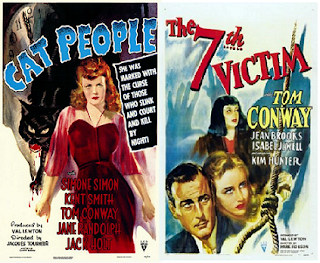
The industrial incentives that encouraged the production, distribution and exhibition of B-films and the function of horror on Cat People (1942) and The Seventh Victim (1943)
If we attempted to define the term B-movie, we would conclude that it is quite problematic a term since its meaning in the film culture, or better in what it is referring to, has been changing through the years. On this paper I will run through the first B-movies as they were named after their appearance for the first time during the 30s and 40s. The history of their phenomenon does not end after that era, but it was then that the rapid changes at their production, distribution and exhibition met the first significant critical evaluations. But even within this time frame, the determination of what was called as B-movies is not an unchallenging aim. As an alternative attempt to examine their phenomenon, on my essay, after at first discussing the very industrial incentives that encouraged their production, distribution and exhibition, I will make a detailed reference to a couple of B-films, namely the Cat People (d. Jacques Tourneour, USA, 1942) and The Seventh Victim (d. Mark Robson, USA, 1943), both of them produced by Val Lewton. More specifically, I will try to demonstrate that, in inextricable harmony with the general requirements and the limitations the producers had to face, we can read their text as a discourse on absence and therefore on the primal element of horror which emanates from its various transmutations. Of course, the films that Val Lewton produced are in their entirety different from the average[1] b-films of that era in many ways, owing to the greater freedom that Lewton had in comparison with the other producers and certainly his quite discussed personal intentions. My analysis of the reasons of the procreation of the Β-films is complementary to my later case study exactly by revealing the wider context these two films, though not representative, can only reflect as an alternative piece of it. We can locate the beginning of the B-movies phenomenon at the block booking[2] and the double bill. As Blair Davis (2012, p.3) mentions, the ‘all-or-none approach to selling films allowed the studios to give exhibitors a handful of top-quality films along with a multitude of second-rate titles[3]’. Gary D. Rhodes (2011, p.58) pinpoints the Depression as determinant for the introduction of the “double feature” on a national scale, since that time the films became shown as double bills, so to say in a given movie theatre they would present two movies each night, with the second to be of inferior quality in relation to the first (Davis 2012, p.3). As it was established, the first movie was an A-level film of high cost with a major cast followed by a lower budget B-movie with more or less undistinguished actors (p.3). Tracing the beginning of the double bills, we shouldn’t ignore the fact that during the 1930s one in four Americans was unemployed so there were not enough money left for somebody to attend to a movie theatre (p.3). Therefore, the independent exhibitors had to make an enticing offer given that the American spectators were not disposed to spend much money on their entertainment[4] (p.3). Their majority advocated the change because they believed that it would be more beneficial and it would increase the turnout (p.3). What was concomitant was the fact that they wanted more films in order to increase the variety of those available to attract the spectators, something that motivated certain producers to get down to the new possibility to create more low-budget movies since the need for more film product was imperative (Rhodes 2011, p.54). We can rightly see the double bills as an effort of the independent theatres to compete with the larger, studio-owned ones which in their turn could not afford to produce at the same time two extravagant films because of the lack of studios, crew and eminent actors, not to mention that a movie’s budget could not be balanced with a single admission price (Davies 2012, p.4). Consequently, they had to separate the production to two categories, the class A and class B in which there would be included the low-budget films (Bjork 1989, p.34). After this demarcation was established, with theatres showing an A class and a B class film successively forming thus the double bills, their general lineaments were formed as well[5]. The first film was a prestigious one with a larger budget and many popular actors while the second one, the B movie, which was presented after the first leading one and moreover had nothing to do with it in terms of comparison, was a film created with mainly meagre funds and not so many well known actors (Davies 2012, p.5). Of course, according to Lee Jacobs (1992, p.2), we should not overlook that always in association with a film’s budget factors like its production, its method of advertisement, the critical attention it called forth or the theatres it was presented at, played their role and always made the distinction between the A and B films clear despite the better promotion they sometimes met verging on the A-film status. By 1937 their success was rapid and the majority of the films produced in Hollywood were B-movies intended for both major and minor studios which in they turn embraced them owing to the guaranteed profits in a new era of block booking (Davies 2012, p.7). The Hollywood studios benefited from their production because they were distributed in a different way and basis than their A-picture counterparts (p.7). The latter were rented to theatres on a percentage basis and the box office revenue was splitted between the studio which served both as producer and distributor and the exhibitor, in opposition with the B-movies which were rented for a flat rental fee without regard to their popularity (p.7). At all events the studios had to ensure their profits and this was succeeded by the producers’ concern that the film’s budget was lower that its expected minimum profit from the flat fee (p.7). Richard Maltby (2006, p.132) elucidates that the economical risks involved in their production were not high and the probable losses were insignificant as the rates of return on these movies were relatively stable, something that did not apply to all cases as it concerns the A-films whose commercial success, even though it would generate higher box-office revenues, was not always granted. The B-movies had one more worthy of remark advantage, that they could be booked in and out of theatres in a flexible manner (Jacobs 1992, p.6). All in all, Paul Kerr (1979/80, p.51) informs us that as a sequel to the above mentioned factors the B-movies became highly appreciated and the producers counted on their success in order to promote their A-films and increase their profits without taking great risks. Now they were a key part of the mode of production utilized in the classical studio system and, considering their part role in the double-bill structure, a new almost vicennial period of great success rose for the film industry, a period often hailed as the golden age of Hollywood (Davies 2012, p.9). What was essential for the producers, as Thomas Schatz (1999, p.43) concludes, was the stability they guaranteed since based on that stability and the in any case absence of economical risk they enabled the studios to keep the operations running smoothly giving the chance to many actors to work regularly, especially the young talented ones. Needless to say, most of the studios’ revenues were earned from the first-run features, however, the unhindered constant production of the B-movies opened a new field convenient for experiments (p.43), provided the opportunity to ‘try new genres’ (Schatz 2012, p.168) and generally opened up new prospects to benefit from these experiments and the broadening ground they revealed to many new directors, writers, cameramen or even actors (Mayer 1947/8, p.172). The studios, on the one hand, had secured their durable activity and on the other the producers favoured the use on a nearly continual basis of sets, stages and actors with a more or less balanced overhead (Taves 1995, p.313). In sum, delineating the B-films origin as a largely subordinate and supportive entity to the Hollywood A-films, they were made in order to satisfy the spectators who asked for more cinematic entertainment, it was a matter of quantity then, and also in order to equilibrate the profits from modestly budgeted films (p.313). The exhibitors in their turn were constantly asking for more films to fill out a double bill conducing thus to the acceleration of such low-budget pictures which came to be knows as B-films (Grundmann, Lucia and Simon 2012, p.9), regulated in a certain historical context. In reference with the B-film noir, a genre in which the two films I will examine on this essay can belong, a number of their characteristics may be attributed, as Paul Kerr (1979/80, p.54) demonstrates, to the above mentioned economic and therefore technological constraints since the paucity of sets or famous actors had been counterbalanced with complicated plots or even convoluted atmosphere. He upholds by using Cat People as evidential of the fact that realism would stand back for the benefit of an expressionist connotation (p.54). Despite the economical restrictions, the B-productions had declared their independent aesthetics and ideology that the front office films were often denied. Centring on Val Lewton in RKO, Annette Kuhn (1999, p.30) informs us that he was able to select and contract a creative personnel functioning as an independent production in a more or less similar way with the units that produced prestige pictures. Occasioned by the meagre funds available and the generic conventions he had to economise on labour and lighting costs by employing low-key effects (p.30). I will now try to analyse how the element of horror applies to these films based on some sequences which I am going to use as characteristic example drawing in parallel attention ―although I am not aiming at that― to the prerequisite that this element is connected with their production’s conditions. However, proemially, it would be useful to cite Paul Kerr’s (1979/80, p.54) observation that an analysis of a noir B-film is ‘nothing more than an attempt to make a stylistic virtue out of economic necessity –the equation, at its crudest, of low budgets with low key lighting – is inadequate: budgetary constraints and the relative autonomy of many B units in comparison with A’s were a necessary but by no means sufficient condition for its formation’. Joel Siegel (1972, p.104) has said that ‘Cat People is, in its best moments, so frightening because it never really shows anything, thus affording us that greatest indulgence of terror – the freedom to frighten ourselves’. Indeed, this is what happens in the sequence when Irena (Simone Simon) and Oliver (Kent Smith) step in the pet shop and all at once the animals feel disturbed. We are right to guess that this is happening because of Irena’s presence and nature, however by no means is this a touchstone, it may be as well a coincidental occurrence. Nevertheless, if Irena represents the source of their alarm, what makes the animals feel threatened, what is she capable of committing, the animal’s disquietude betokens something for the moment impalpable. In a similar simple way, the unknown woman’s presence mumbling some alien words that nobody understands during the wedding ceremony of the young couple achieves to give us fright mainly by making us wonder about its meaning. She does not frighten us with what she offers, but by refusing to present the horror’s real nature, as if the element of horror itself has not got any meaning or as if it gets identified with the absence of a meaning. It springs from somewhere, in this connection from this particular woman’s presence, but what we finally take for granted directs us to the cross-road where every possible explanation seems justifiable. When we later watch Alice (Jane Randolph) walking at night in the dewfall, the unknown factor that makes her feel frightened appears absent, what is present is the horror’s clue, not by hiding something that refuses to reveal itself, but by only presenting shades which may conceal anything. Finally, the absence, since depicted on screen, pictures itself in order to get perceived by the spectators. The dipole of presence and absence at each of its ends, as J. P. Telotte (1985, p.16) ascertains, operates as a structural principle at all levels in Cat People, especially absence which prompts their distinctive fantasy aesthetics (p.22). Interestingly enough, it was the limitations of time or money that dictated the less concern for a spectacular film and not the producers’ intention to make the audience believe that something bizarre or even nightmarish was screened (p.22). The producers used this ineluctable scenografy to their own advantage so making the dark patches to appear frequently during the film, consolidating thus their position as inextricable structural and thematic constituent elements (p.22). So we might as well suggest that owing to the film’s production in the same way that what appears absent finally consists the cause of horror springing from the absence, it also fills the absence of the narration/representation. The any impossibilities are not only covered immediately, but on the contrary, the impossibilities themselves are correlative with the factor of absence, as if the film could not be created otherwise. The director of photography in both films was a specialist in shadowy, low-keyed shooting, serving thus in parallel another purpose, that of the at all costs obscurity of the economic limitation of the film’s production (Siegel 1972, p.33). In Lewton’s most personal work, as it has been hailed (Bansak 1995, p.186), the Seventh Victim, the shades and the whole charcoal grey atmosphere do play a dominant role as motives and this is what Lewton and Tourmeur succeed, to make us focus on the story premising its being presented in a restrained, highly formalised style (Siegel 1972, p.102). During the sequence when Jacqueline (Jean Brooks) attempts to escape from the unknown man that chases her, it is not him who horrifies us but the contingency of her life being threatened. The reason why it rises, the reason why the feeling of horror we gradually face has reached its outmost does not spring because of our identification with her but of our having perceived that the film’s concept is death whether regarded as redemptive or not. We do not pass the heroine for a murderee, nevertheless the outcome will also consist the result of a quest. The stimulating point is that all these get simply effectuated by latent determinant clues during the film and so the essence of mystery kept on rising while they transpired. In other words, it is not matter of an oncoming mortal blow but of our own plunge into the film’s whole world, a world de facto obscure. Besides if we call to mind the sequence in which the members of a fraternity beg her to sip the lethal poison, though not impressive as attempted premeditated murder, we shall see that it is the intenseness of what is said that frightens us foreshadowing its perpetration. As Todd McCarthy and Charles Flynn (1975, p.22) have underlined the ‘elimination of stage business, of entrances and exits, gives most Bs a strange, almost cryptic air or flatness and unreality’ but with the semantic differential that Jacques Tourneur went to any lengths in order to turn all these minimal resources into expressive devices. Of course, as Manny Farber (1975, p.107) informs us, Val Lewton was in full consciousness of the limitations he had to exceed, so by making use of these adventitious finds he was launching new guidelines for the spectators who tended to think more about his material than it warranted. We can really consider the film in the context of a transition between the endmost confines of life and death, of inside and outside (Jacqueline inside and outside the private school, her sister inside and outside the fraternity), as well as in the context of an inversion since life is presented as impenetrable impediment and death as redemptive. The film in fine does not function by mainly what is screened before the spectator, but by making us contemplate based on what takes place and, decidedly, under which circumstances and ambience. Anything that would simply appear limited in a B-film, on this occasion, by causing the aforesaid impenetrability, makes it successful. In Lewton’s films beauty lies in what is failed or not good enough (Nemerov 2005, p.4) and forasmuch as the available funds he favored darkness and the unseen generally so his audiences could imagine horror instead of see it (p.9). The film’s beauty in very deed emanates from the concept of impossibility, latent throughout the film, an impossibility associated with those of the production. By extension, the use of shadiness in The Seventh Victim, the plot of which takes place mainly at night, helps to accompany what is suggested through the dialogues and thereafter with them alone to suggest something impossible too, something near by devastation, hence death. Lewton’s films are better known for their use of light and shadow and thus for their sombre essence and the air of gloominess they give off which form a preoccupation with loneliness and death (Hanson and Neale 2012, p.258), since everything through its absence brings to the surface relative themes. In this connection, the feeling of loneliness in the movie has to do with the deprived, the effort for the impenetrability to get broken through. The whole ambience is definitely nothing but a piece of the film’s aesthetics which, though a b-movie, does not lack ‘gentility and class’ (Miller 1973, p.312). At last, what Lewton accomplished with these two movies is to prove that horror is closely interwoven with the uncertainty and, arguably, from what is absent. The B-movie production can rightly be considered as the ideal medium for such films, by and large for the films that Lewton produced. The absence on its various transmutations conduces to our examining the things beyond their surface and the confines of real and raises doubts about the objects’ hypostasis (Telotte 1985, p.20). We should add that, as belonging to the category of B-films, the Cat People and The Seventh Victim, keeping in mind that they were produced in a short period of time and with a low budget, do finally make us cogitate about what makes a film. By way of their simpleness these films achieve to terrify us not by being limited within their possibilities, but by adopting in their text the limits of their production, constructing on the notion of absence the prime causes of horror.
____________________________________ [1] If such a term can be rated as approved. [2] Which was part of the then applied monopoly, as Paul Kerr (1979/80, p.56) also affirms by making reference to ‘the monopoly structure of the industry – which had been initially, if indirectly, responsible for the B phenomenon’. [3] However, Kerr’s (1979/80, p.54) observation that ‘the double bill was not simply the result of continuing any two films, one A and one B, but often depended on a number of quite complex contrasts’ is one worthy of remark. [4] Kyle Dawson Edwards (2011, p.386) mentions that ‘[w]hile the exhibition practice of pairing two feature-length films in a single admission program, known as the double feature or double bill, originated as early as 1915 and occasionally was used as a novelty program throughout the 1920s, most scholars trace its emergence to the late 1920s and early 1930s, when subsequent-run independent theatres in New England hoped to draw depression-era consumers with a “two for the price of one” value proposition’. [5] Paul Kerr (1979/80, p.52) reminds us of the ‘[c]onstraints at both the production and distribution ends of the industry [which] mean[t] that the running length of B’s fluctuated between about fifty-five and seventy-five minutes'.
Bibliography
Bansak, Edmund G. (1995) Feering the Dark: The Val Lewton Career. London: McFarland & Company, Inc., Publishers.
Bjork, Ulf Jonas (1989) ‘Double Features and B Movies: Exhibition Patterns in Seattle, 1938’, Journal of Film and Video, 41(3), pp. 34-49.
Davis, Blair (2005) The Battle of the Bs: 1950s Hollywood and the Rebirth of Low Budget Cinema. London: Rutgers University Press.
Edwards, Kyle Dawson (2011) ‘“Monogram Means Business”: B-film Marketing and Series Filmmaking at Monogram Pictures’, Film History: An International Journal, 23(4), pp. 386-400.
Farber, Manny (1975) ‘Val Lewton: Unorthodox Artistry at RKO’, in Todd McCarthy and Charles Flynn (eds.) King of the Bs: Working Within the Hollywood System: An Anthology of Film History and Criticism. New York: E.D. Dutton & Co., Inc., pp. 105-110.
Flynn, Charles and McCarthy, Todd (1975) ‘The Economic Imperative: Why was the B Movie Necessary?’, in Todd McCarthy and Charles Flynn (eds.) King of the Bs: Working Within the Hollywood System: An Anthology of Film History and Criticism. New York: E.D. Dutton & Co., Inc., pp. 13-43.
Grundman, Roy, Lucia, Synthia and Simon, Art (2012) The Wiley-Blackwell History of American Film, Volume II, 1929 to 1945. Oxford: Wiley-Blackwell.
Hanson, Helen and Neale, Steve (2012) ‘Commanding the Sounds of the Universe: Classical Hollywood Sound in the 1930s and early 1940s’, in Steve Neale (ed.) The Classical Hollywood Reader. London: Routledge, pp. 249-261.
Jacobs, Lee (1992) ‘The B Film and the Problem of Cultural Distinction’, Screen, 33(1), pp.1-13.
Kerr, Paul (1979/80) ‘Out of What Past? Notes on the B Film Noir’, Screen Education, 32-33, pp. 45-65.
Kuhn, Annette (1999) ‘RKO Radio Pictures’, in Pam Cook and Mieke Bernink (eds.) The Cinema Book. 2nd edn. London: British Film Institute, pp. 28-30.
Maltby, Richard (2003) Hollywood Cinema. 2nd edn. Oxford: Blackwell Publishing.
Mayer, Arthur L. (1947/8) ‘An Exhibitor Begs for “B’s”’, Hollywood Quarterly, 3(2), pp. 172-177.
Miller, Don (1973) B Movies. New York: Ballantine Books.
Nemerov, Alexander (2005) Icons of Grief: Val Lewton’s Home Front Pictures. London: University of California Press.
Rhodes, Gary D. (2011) ‘“The Double Feature Evil”: Efforts to Eliminate the American Dual Bill’, Film History: An International Journal, 23(1), pp. 57-74.
Siegel, Joel (1972) Val Lewton: The Reality of Terror. London: Secker & Warburg.
Taves, Brian (1995) ‘The B film: Hollywood’s Other Half’, in Tino Balio (ed.) Grand Design: Hollywood as a Modern Business Enterprise, 1930-1939. Berkeley: University of California Press, pp. 313-350.
Telotte, J. P. (1985) Dreams of Darkness: Fantasy and the Films of Val Lewton. Urbana: University of Illinois Press.
Schatz, Thomas (1999) Boom and Bust: American Cinema in the 1940s. London: University of California Press.
¯¯¯¯¯¯¯¯ (2012) ‘Hollywood: The Triumph of the Studio System’, in Steve Neale (ed.) The Classical Hollywood Reader. London: Routledge, pp. 167-178.
Acknowledgment Ι would like to express my sincere thanks to Christos Aggelakopoulos for his diligent philological support.
The Feminist Ideology in Germaine Dulac’s La Souriante Madame Beudet (1922)
Germaine Dulac’s La Souriante Madame Beudet (France, 1922) is hailed as one of the first feminist films in the history of cinema, a term nevertheless quite abstract and thus problematic. According to Pam Cook (1985, p.356), ‘[c]inema is taken by feminists to be a cultural practise representing myths about women and femininity’ and therefore ‘[i]ssues of representation and spectatorship are central to feminist film theory and criticism’. However, as Jennifer Hammett (1997, p.85) has mentioned, after Laura Mulvey and Claire Johnston identified the constituent role of language in relation to the operation of ideology, the feminist film theorists by conflating Althusser’s and Lacan’s theories[1] concluded that both representation and ideology are correlative. Defining the film ―which is a system of representation― as a point of production of definitions, Elizabeth Cowie (2000, p.49) argues that it can become an index mark for definitions of women through their representations. These definitions are mainly produced by socio-political and economic practices and then ‘reproduced, reflected or distorted by film’ asserting it as an ‘ideological practise’ (p.48). The socio-political climate in which La Souriante Madame Beudet was created is singularly interesting, because as Tami Williams (2010, p.404) has rightly pointed out, ‘[i]in contrast to its mythical designation, “les années flles” (the roaring ’20s), in France of the 1920s there was a deep fissure between women’s desires to continue their wartime experience of liberty on the homefront, and the official moral discourse of neo-natalism, which dictated conservative perceptions of class, gender, and sexuality’. Germaine Dulac by filming within an ‘intellectual, political and aesthetic milieu’ and having realized the necessity to deconstruct the dominant models of her era (Armitage 1995, p.132), became a ‘moderate feminist’ who through ‘symbolic technical effects and abstract visual associations’ in her films ‘communicate[d] her progressive […] ideas through a symbolist network based on “suggestion”’ (Williams 2010, p.404). On this paper I will examine La Souriante Madame Beudet as an exemplary paradigm of the use of these techniques, which allowed Dulac to create a text with inextricable elements of fantasy in a correlative way, making her film a by intention product of feminist ideology. More specifically, through a sequence by sequence textual analysis of the film I will try to demonstrate, on the one hand, in which ways the film carries a distinct ideology and, on the other, in which ways and to what extent this ideology can be regarded as a feminist one[2].
The film begins with four outdoor shots of a countryside. The next shots are preceded by the inscription “Behind the peaceful facades, souls… passions…”[3] importing that what exists behind the forefronts of the houses, within the private spaces is not peaceful. Germaine Dulac seems to call us to see beyond the surfaces of the society’s limits, maybe beyond the surfaces of a film’s characters and even beyond the surface of her film itself. She calls us to set about a deeper and alternative reading in order to understand things that will not be explicitly presented. In the next shot what we only see is the hands of Madame Beudet (Germaine Dermoz) playing the piano and the hands of her husband (Alexandre Arquillière) who is possibly counting some coins. This shot is created by two individual initial ones, presented here in a contradictive way, calling to attention the connection of the main heroine with the sentimental world of music and art in general and that of her husband with money, work, economical independence and capitalism in which his authority is mainly based[4]. Details like these will come in useful in semiological terms for similar conclusions during the film. Thereafter we see Madame Beudet playing the piano alone when a shot of reeds round a lake is being displayed. It is the first shot that signifies a depiction of Beudet’s inner fantasies. We see what she imagines. As I have already mentioned, the role of fantasy is determinative since Dulac chose to express her ideological positions in the film. If we conceptualize the main heroine as a social subject, and consider Teresa de Lauretis’ (1995, p.82) claim that the representation of the unconscious fantasies is important for the understanding of the physic contradictions and divisions in the social subject, Dulac’s intentions are getting gradually disclosed and through the use of the depiction of Beudet’s fantasies judged to be succeeded. By depicting the contradictive with the reality inner desires of her heroine, Dulac demonstrates the contradiction between what she has, or most importantly what is permitted to her, and what she really needs and wants. The director by relying on Beudet’s waking dreams reveals to the spectator the heroine’s inner reality, how she experiences it. Through this contradiction between her inner and outer reality, or in Colin MacCabe’s (1986, p.182) words, through the ‘different “views” of reality which are articulated together in different ways’ Dulac, to a certain extent, challenged the maintenance of the existing social reality calling thus the audience of her era to comprehend the need for a change[5].
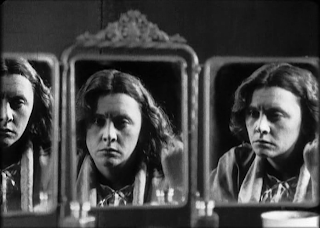
On the next sequences after being introduced to the characters of her husband and his colleague (Jean d'Yd) in their common workplace, we watch once again Madame Beudet sitting and reading a book ―another sign of her connection to the word of art― while her husband comes in and sits at his desk without greeting her. When their maid (Yvette Grisier) comes in to deliver the mails, he asks her to give him a magazine that seems to belong to his wife and examines it. This detail apparently underlines his control on her. When he later suggests her going with him to watch Faust, she declares her disinclination, a reaction that caused his anger. The inscription “Dreams…” precedes the next sequence which is consistent of what Beudet fantasizes. Inspired by an advert of a car in her magazine, she imagines herself riding one across the clouds. She then glances at her repressive husband and after that at the photo of a tennis champion in her magazine, so she imagines him coming and taking her away. Her desire is to get rid of her husband and quite interestingly she imagines that this may become true when a man who would be able to save her arrive. It was indeed difficult for a woman of her era to divorce her husband; Beudet could only look to a sleazy factor like his death, a factor that maybe justifies her attempted murder. The reason why Madame Beudet is haunted by the need to create a new, better fantastic reality is because that other world that she tries to reconstruct provides a secure retreat for her. After jesting and asking over his friends, a stereotyped action for him as the inscription informs us, he approaches his wife and molests her while reading her magazine in order to command her attention. Later on he removes the vase on the table according to his personal taste, placing it in the middle of it. When Beudet perceives the change she puts it back in its initial place. Dulac highlights that only through these little insignificant ways her heroine is able to resist and impose her taste and personal will. As any other women of her era, she has nohow to express her differentiation, to asseverate her implicit desires, so she tries through these niggling details not to lose her self within the limits of her husband’s authority. On a next sequence we watch them eating together and Madame Beudet seems to get annoyed at the inelegant way her husband devours his food. But she is not reacting and on this point her subservient position seems explicitly revealed. While both of them have problems with each other, he is the only who has the exclusive right to complain, and not Beudet who remains silent and obedient. When their friends arrive at their home in order to go altogether to the opera and Madame Beudet insists on her decision not to go with them, her husband repeats his joke. On this point it would be interesting to mention that Dulac intends to make the spectator identify with her main heroine since the husband is presented through a quite graphical way. His expressions are over-exaggerated and Dulac brings them out through medium shots of him and close ups to his face. We will be able to justify Beudet only if we feel exactly as she feels, what interests Dulac is her own perspective, the feminine one. As her husband getting ready to go out he repositions the vase on the table and although her wife helps him gladly to wear his clothes, when she dares to play the piano, he does not only impede her, but also locks the piano and secretly pockets the key. She is getting disappointed to find the piano locked so she chooses to read a poem. During the poem’s recitation she realizes how different her real life is compared with the fantastic one described in the poem. This scene illuminates the corner stone of Dulac’s theory that both art and intellectuality in general can play an important, if not the most important, role to the awakening of a woman. She mainly focuses on the female audience and asks them not only to watch her film, but to compare the situations that are being depicted with their own lives. In addition, in order to underline this contradiction, she shows us at first an extract from the poem succeeded by an image of her real life which comes in opposition with what is being described in the poem. The contradiction as a visual device plays an important role to the whole film. We are always aware of the other side and perspective of the things, and there is not possibility for them to change if we do not firstly realize their very proneness to get altered. We have to imagine a better reality like her heroine and the whole film foreshortens exactly that, a Germaine Dulac’s fantasy. Ensuant to the above, her maid comes in to ask if she allows her to go out with her fiancé. Madame Beudet imagines him beside her and gets pleased with his certain tenderness. We can consider this once again as a contradiction between her maid’s connubial life and her own. Madame Beudet instinct with solidarity permits her to go, a conspirational solidarity among women in order to achieve something. Of course, the awakening is an individual process, but the change can be succeeded in terms of a collective effort. The desperate Madame Beudet after correcting the position of the vase, looks herself on the mirror. What she sees is her identical self and not a better image of it. The mirror renders only the reality… Her desires remain immitigable. The interstitial inscription “And always the same skyline…”, seems to confirm that despite her desire for a change, nothing changes, everything remains at the inmost recesses of her heart as herself remains subjugated among the four walls of her house. The second chapter of the film begins with Madame Beudet fantasizing a fiancé coming for her, but the picture of her husband on the wall reminds that he is an impediment in her happiness. Later on she plays with her wedding ring, a symbol of her bond, the inscription “Obsession” appears on screen and she imagines her husband coming menacingly from the balcony towards her. He reappears close beside her as she stumps towards the window. She fantasizes him over and over again, always as an obtrusion, as somebody whose preoccupation confines him to only put back the vase on the table and jest. This last image possibly inspires her to load the gun with bullets. In the next morning we see him falling asleep while getting ready to go to his job dreaming of the female actor of the previous night. Although Dulac shows us what he is dreaming, all these are just component images of his dreams, and not like in Beudet’s case a depiction of his imagination. That being so, Beudet’s point of view is not disrupted and remains dominant. At the same time Beudet suffers a broken sleep and when she wakes up and dolefully looks around the room, an oscillating pendulum suddenly appears. This still does not seem to make up a day-dream of the heroine, but to stand there only for the spectator[6]. It intercedes between her and us, it purports to be a fancy of ours, a fancy fictitiously enforced by the director, in the same way she enforces it to her heroine, her world is just like hers, a fancy. Consequently, Dulac does not simply call us to get identified with Beudet, but she compels us to commiserate her through a clock finger ticking between her and us. After that she imagines a criminal court, a possible indication that she already feels regretful for her yesterday’s act and in all likelihood she wants to wake up and correct it, but realising her husband’s presence at the farther end of the room she pretends to be sleeping. Her husband wants to kiss her, but her abrupt awaking stops him. She is not the only one who has problem with their marriage, but in comparison to her, he as a man has greater authority to resolve this situation. When he leaves the room and she goes to stand near the window the word “Remorse” is written in an inscription confirming her decision to remedy her mistake. After some unsuccessful attempts to enter her husband’s office to apologize, by reason of the many guests, she sits before a mirror reflecting the face by three different angles to comb her hair with a desperate countenance. Now we are watching her reflex tripled, her reality remains dreary and with her decision not to go out with him yesterday her problems would treble instead of unravel the situation. In the meantime, downstairs, her husband complains to his friend about his wife. He wrests a doll and snaps it in two telling his friend that this is what women need. Here, the connotation of the social supremacy of the man because of his might is clearly stated. The man, as a by nature more powerful animal imposes his will to the women. In order to go by their will they need violence and submission. The phrase “You know what they need” in the inscription is of high importance. This reminds us of Teresa de Lauretis’ opinion (cited in Rodowick 1984, p.142) that
‘[t]he two terms, femininity or masculinity, do not refer so much to qualities or states of being inherent in a person, as to positions which she occupies in relation to desire. They are terms of identification. And the relation between them, Freud seems to suggest, is a specific character of female subjectivity… The analogy that links identification-with-the-look to masculinity [activity, sadism] and identification-with-the-image to femininity [passivity, narcissism or masochism] breaks down precisely when we think of a spectator alternating between the two.’
And this is what the director exactly attempts, to make us muse on the aforesaid dipole, but according to Beudet’s aspect. As Claire Johnston (1999, p.33) rightly mentions, ‘[w]ithin a sexist ideology and a male-dominated cinema, woman is presented as what she represents for man’. In La Souriante Madame Beudet, however, we face an opposition, that is the man is represented the way Madame Beudet perceives him and Beudet in her turn in the way the director perceives her. In parallel, Mr. Beudet has kept the doll’s broken head in his pocket. Alone in his office later he examines it closely. Finally he replaces the various objects of his wife ―the vase among them― and sits at his desk. Pondering the monthly outgoings he asks the maid to call his wife who later comes after a few moments hesitated. Obviously crabbing about the outgoings he takes his gun and threats that he will commit suicide, his classic suicidal joke, an action that frightens Beudet. But later, telling that she deserves such a fate, he aims at her and pulls the trigger drawing amiss. He is running towards her thinking that she wanted to commit suicide and embraces her saying that he could never live without her. He is tensely touched with emotion in opposition with her who seems to be awe-striken and cofused. At a time in a painting behind them two lay figures appear who look alike them and move cuddled together till the drop-curtain of this imaginative theatre closes and the word “THÉATRE” is written on the curtains. This particular interstitial scene seems to be there only for the spectator and not for Madame Beudet. The heroine’s reality is ironically parallelized with the usually happy endings of a play. Dulac reminds us that what we are watching is nothing but a piece of art, an enactment decidedly able to affect our reality, suffice it not to be perceived with the aspirations of a passive spectator who no matter what will happen in the film, he insists on a happy ending or not, a catharsis or a catastrophe. As the reality of the lay figures limited in a smaller frame out of a whole in which the film is displayed consists a piece that belongs to the reality of the heroes, so relatively the whole film, what is inhered in its frame, is a piece of our own reality. Its heroes are nothing else than what Jean Louis Baudry (1985, p.540) calls ‘specular reflections’ of ourselves, just like the lay figures in this sequence consist metonymic reflections of the heroes. Something created by others becomes a part of our own reality and it must be regarded as such with the prerequisite to open up new prospects, namely its narrative end not to bring on the end of its possibilities. Our being compromised with the end of the fiction would consist an act of reconciliation and passivity of the ideology it carries. Finally, what the director also achieves with the above mentioned find is to prepare us to realize the unprecedented irony she inculcates in the last sequence of the film. Although the inscription predisposes us with an ostensible tranquility (“In the peaceful streets, without horizon, under the low sky, together by habitude...”), we watch the twain walking along an upward gradient that may symbolises the oncoming hard goings for both of them, especially Madame Beudet. Moreover, as they gradually ascend, Mr. Beudet walking all the more on the right side of the street, he forces his wife to walk on the pavement while he keeps on walking on the street. This is the last sequence of the film and the present detail can be perceived as a remark by the director that no matter the seemingly happy ending, the difficulties are many and deep and it will not be possible for the woman to overcome them as long as she is put aside, outside of society ―outside of the main road, the pavement. For all that, the woman must not lose heart, she has to struggle for her rights, otherwise the only solution will always be the compromise. By inference, Barbara Klinger (1981, p.142) has mentioned about La Souriante Madame Beudet that ‘[t]he film, through a level of self-reflexiveness-the obvious theatricality of its resolution and its visual inscription of the authorial voice through Madame Beudet’s point-of-view shots-represents a feminine discourse’. As a matter of fact the dominant angle of view of the film is that of the main heroine, who furthermore can be easily identified with Dulac herself[7]. However, as Rosanna Maule (2002) claims, in the film the ‘femininity marks a strategy of representation that explores women’s fantasies and desires’. This is what mostly Dulac is interested to express. She does not suggest concrete proposals, but she presents them through her female heroine’s desires and imaginations. She deploys the cinematic medium to present a woman’s desires ―endeavouring to identify the spectator with her―, desires that were impossible to get expressed then, like the need to get rid of your husband or the pangs of love with a lover which were incompatible and against the dominant ideology of that era. Therefore Dulac ventures to cut in the prevalent sexual ideology of that time by exposing the desires of a woman almost in their entirety, depicting thus a heroine not as herself imagines her but as the male part of the society. Again, what is more important is the fact that Dulac defends the woman’s independence in both the family and the society not by simply creating a film with a content that may be perceived and interpreted as dissentient to the prevailing circumstances. Now that I have run through the whole movie, it is worth the try to return and focus on its end setting thus off an other considerable point/way whereby the defiance/attack of Dulac is not confined in the content of a film, so to speak in an alternative representation of a female heroine, but at the narration itself. Bill Nichols (1988, p.78) mentions about the association between narratology and ideology, and more particularly the closure of a narrative:
‘[n]arrative […] shares with ideology a set of structural mechanisms serving to generate apparent unity and coherence. It proposes a sense of closure; it provides the sense of an ending. Narrative characterizes occurrences within a given domain in such a way to make these occurrences systematic and therefore comprehensible.’
However, as we have already pinpointed, Dulac refuses an essential closure for her film. This is only a typical and superficial and perhaps a fallacious deduction since as we have already mentioned, the director impels us from the beginning to get beyond the surface. She does not simply render a story about a woman, she enacts a situation that on the one hand sets out from the reality and on the other it must return at its source, the self-same reality. This is succeeded by reminding us ―as I have already demonstrated― our role as spectators and by calling us to identify ourselves with the main heroine and share her sentiments and impasse. It is not she that has to labour seeking an outlet but the spectators for what she represents. The closure is given to the spectator and concerns things beyond the film’s framework. As regards the woman, Dulac does not choose to idealize her heroine or just render an inverse idealistic model of a perfect woman who manages to come through since this would be judged as unrealistic. She is not additionally interested in putting on the map a certain feminist ideology, an ideology about the women’s social position, to suggest a model. What she presents are women in their own right within the limits of the dominant ideology. What matters most is that an ideology expressive of the necessities of life a woman has as an equivalent member of the society is imperative. Germaine Dulac herself intervenes through her work by actively taking a hand in the representation of what could not easily be represented. Her film is not one-sided in the sense that it tries to defend something specific by subject, since its subject is exactly the necessity to focus on a woman’s desire. Hence, even the film’s title can be taken as an ironic one as the times with Madame Beudet smiling are not many. Dulac chooses to depict what prevents her from doing so.
____________________________________
[1] In particular Althusser’s definition of ideology as ‘“the imaginary relationship of … individuals to their real relations of existence” with Lacan’s theory of the subject as constituted through language’ (Hammett 1997, p.85).
[2] I would not exaggerate if I declared on this point that the presumptive reflection of Janet Bergstom’s (1998, p.162) notion about the ‘fundamental interdependence between film theory and textual analysis’ on my analysis makes up a secondary purpose of mine. [3] The inscriptions quoted in my essay are translations from the French and German ones of the original film.
[4] It is not insignificant that, in contrast with his wife, the husband is standing upright. [5] Robert Lapsley and Michael Westlake’s (1988, p.169) mention that one of the definitions of the realistic filmic text rises to prominence its being conformable to the spectator’s existing ideology or represents reality as a particular society, proposes and assumes it. [6] The case is reminiscent of an other film, the Los Olvidados (d. Luis Buñuel, Mexico, 1950) in which the wings coming down in the dream sequence can not be perceived by Pedro, but exist there only for the spectators. [7] For further reading about this identification, see Musser 2007.
Bibliography
Armatage, Kay (1995) ‘Nell Shipman: A Case of Heroic Femininity’, in Laura Pietropaolo and Ada Testaferri (eds.) Feminisms In the Cinema. Bloomington: Indiana University Press, pp. 125-145.
Baudry, Jean Louis (1985) ‘Ideological Effects of the Basic Cinematographic Apparatus’, in Bill Nichols (ed.) Movies and Methods, Volume II: An Anthology. London: University of California Press, pp. 531-542.
Bergstom, Janet (1988) ‘Enunciation and Sexual Difference’, in Constance Penley (ed.) Feminism and Film Theory. London: BFI Publishing, pp. 159-185.
Cowie, Elizabeth (2000) ‘Woman as Sign’, in E. Ann Kaplan (ed.) Feminism and Film. Oxford: Oxford University Press, pp. 48-65.
De Lauretis, Teresa (1995) ‘On the Subject of Fantasy’, in Laura Pietropaolo and Ada Testaferri (eds.) Feminisms In the Cinema. Bloomington: Indiana University Press, pp. 63-85.
Hammett, Jennifer (1997) ‘The Ideological Impediment: Feminism and Film Theory’, Cinema Journal, 36(2), pp. 85-99.
Johnston, Claire (1999) ‘Women’s Cinema as Counter Cinema’, in Sue Thornham (ed.) Feminist Film Theory: A Reader. Edinburgh: Edinburgh University Press, pp. 31-40.
Klinger, Barbara (1981) ‘Conference Report: Conference on Feminist Film Criticism’, Camera Obscura, 3(17), pp. 136-143.
Lapsley, Robert & Westlake, Michael (1988) Film Theory: An Introduction. Manchester: Manchester University Press.
MacCabe, Colin (1986) ‘Theory and Film: Principles of Realism and Pleasure’, in Philip Rosen (ed.) Narrative, Apparatus, Ideology: A Film Theory Reader. New York: Columbia University Press, pp. 179-197.
Maule, Rosanna (2002) ‘The Importance of Being a Film Author: Germaine Dulac and Female Authorship’, Senses of Cinema, 23. [Online] Available at: http://sensesofcinema.com/2002/feature-articles/dulac (Accessed: 26 November 2013).
Musser, Charles (2007) ‘The Clash Between Theater and Film: Germaine Dulac, André Bazin and La Souriante Madame Beudet’ New Review of Film and Television Studies, 5(2), pp. 111-134.
Nichols, Bill (1988) Ideology and the Image: Social Representation in the Cinema and Other Media. Bloomington: Indiana University Press.
Rodowick, D. N. (1988) The Crisis of Political Modernism: Criticism and Ideology in Contemporary Film Theory. Urbana: University of Illinois.
Smelik, Anneke (1985) ‘Feminist Film Theory’, in Pam Cook and Mieke Bernink (eds.) The Cinema Book. 2nd edn. London: British Film Institute, pp. 353-365.
Stam, Robert (2000) Film Theory: An Introduction. Oxford: Blackwell Publishing.
Williams, Tami (2010) ‘Toward the Development of a Modern “Impressionist” Cinema: Germaine Dulac’s La Belle Dame sans merci (1921) and the Deconstruction of the Femme Fatale Archetype’, Framework: The Journal of Cinema and Media, 51(2), pp. 404-419.
Acknowledgment
Ι would like to express my sincere thanks to Christos Aggelakopoulos for his diligent philological support.
'Για τα έθιμά τους αξίζει να αναφέρω τα εξής. Κάθε άνδρας παίρνει μία γυναίκα, αλλά τις μεταχειρίζονται από κοινού. Οι Έλληνες τη θεωρούν συνήθεια των Σκυθών αυτή, ενώ στην πραγματικότητα ανήκει στους Μεσσαγέτες. Αν ένας άνδρας επιθυμεί μια γυναίκα, το μόνο που έχει να κάνει είναι να κρεμάσει τη φαρέτρα του μπροστά στην άμαξά της κι έπειτα την απολαμβάνει χωρίς φόβο. Έχουν μόνον έναν τρόπο να καθορίζουν την κατάλληλη στιγμή να πεθάνουν, τον εξής: όταν ένας άνδρας είναι πολύ γέρος, όλοι οι συγγενείς του κάνουν μια γιορτή και τον περιλαμβάνουν σε μια γενική θυσία προβάτων· έπειτα, βράζουν τη σάρκα και την τρώνε. Αυτό θεωρούν τον καλύτερο τρόπο να πεθάνει κανείς. Αυτοί που πεθαίνουν από αρρώστια δεν τρώγονται, αλλά θάβονται και θεωρείται ατυχία να μη ζήσει κανείς αρκετά ώστε να θυσιαστεί. Δεν είναι γεωργοί, αλλά ζουν με κρέας και ψάρια, τα οποία αφθονούν στον Αράξη. Πίνουν πολύ γάλα. Ο μόνος θεός που λατρεύουν είναι ο ήλιος, στον οποίο θυσιάζουν άλογα, γιατί πιστεύουν ότι θυσιάζουν το γρηγορότερο ζώο στον ταχύτερο θεό.'
Ηρόδοτος, Ιστορία 1: Κλειώ, μτφρ. Φιλολογική Ομάδα Κάκτου, εκδ. Κάκτος
'Μόνος, παρατηρούσε τον ουρανό που έσβηνε, το σκοτάδι να βαθαίνει. Κοίταζε τον ορίζοντα που πνιγόταν, γιατί ήξερε από πείρα τους σπασμούς που θα προκαλούσε η επιθανάτια αγωνία του. Και στο σκοτάδι μπορούσε να ακούει καλύτερα, να ακούει τους ήχους που η μέρα τους είχε κρύψει, ανθρώπινους ψιθύρους, για παράδειγμα, και τη βροχή στο νερό.'
Σάμουελ Μπέκετ, Μερσιέ και Καμιέ, μτφρ. Άρης Μπερλής, εκδ. Ύψιλον