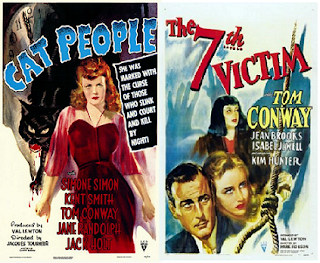
The industrial incentives that encouraged the production, distribution and exhibition of B-films and the function of horror on Cat People (1942) and The Seventh Victim (1943)
________________________________________________________________________________
Ioannis Tsirkas University of Sussex
If we attempted to define the term B-movie, we would conclude that it is quite problematic a term since its meaning in the film culture, or better in what it is referring to, has been changing through the years. On this paper I will run through the first B-movies as they were named after their appearance for the first time during the 30s and 40s. The history of their phenomenon does not end after that era, but it was then that the rapid changes at their production, distribution and exhibition met the first significant critical evaluations. But even within this time frame, the determination of what was called as B-movies is not an unchallenging aim.
As an alternative attempt to examine their phenomenon, on my essay, after at first discussing the very industrial incentives that encouraged their production, distribution and exhibition, I will make a detailed reference to a couple of B-films, namely the Cat People (d. Jacques Tourneour, USA, 1942) and The Seventh Victim (d. Mark Robson, USA, 1943), both of them produced by Val Lewton. More specifically, I will try to demonstrate that, in inextricable harmony with the general requirements and the limitations the producers had to face, we can read their text as a discourse on absence and therefore on the primal element of horror which emanates from its various transmutations. Of course, the films that Val Lewton produced are in their entirety different from the average[1] b-films of that era in many ways, owing to the greater freedom that Lewton had in comparison with the other producers and certainly his quite discussed personal intentions. My analysis of the reasons of the procreation of the Β-films is complementary to my later case study exactly by revealing the wider context these two films, though not representative, can only reflect as an alternative piece of it.
We can locate the beginning of the B-movies phenomenon at the block booking[2] and the double bill. As Blair Davis (2012, p.3) mentions, the ‘all-or-none approach to selling films allowed the studios to give exhibitors a handful of top-quality films along with a multitude of second-rate titles[3]’. Gary D. Rhodes (2011, p.58) pinpoints the Depression as determinant for the introduction of the “double feature” on a national scale, since that time the films became shown as double bills, so to say in a given movie theatre they would present two movies each night, with the second to be of inferior quality in relation to the first (Davis 2012, p.3). As it was established, the first movie was an A-level film of high cost with a major cast followed by a lower budget B-movie with more or less undistinguished actors (p.3).
Tracing the beginning of the double bills, we shouldn’t ignore the fact that during the 1930s one in four Americans was unemployed so there were not enough money left for somebody to attend to a movie theatre (p.3). Therefore, the independent exhibitors had to make an enticing offer given that the American spectators were not disposed to spend much money on their entertainment[4] (p.3). Their majority advocated the change because they believed that it would be more beneficial and it would increase the turnout (p.3). What was concomitant was the fact that they wanted more films in order to increase the variety of those available to attract the spectators, something that motivated certain producers to get down to the new possibility to create more low-budget movies since the need for more film product was imperative (Rhodes 2011, p.54). We can rightly see the double bills as an effort of the independent theatres to compete with the larger, studio-owned ones which in their turn could not afford to produce at the same time two extravagant films because of the lack of studios, crew and eminent actors, not to mention that a movie’s budget could not be balanced with a single admission price (Davies 2012, p.4).
Consequently, they had to separate the production to two categories, the class A and class B in which there would be included the low-budget films (Bjork 1989, p.34). After this demarcation was established, with theatres showing an A class and a B class film successively forming thus the double bills, their general lineaments were formed as well[5]. The first film was a prestigious one with a larger budget and many popular actors while the second one, the B movie, which was presented after the first leading one and moreover had nothing to do with it in terms of comparison, was a film created with mainly meagre funds and not so many well known actors (Davies 2012, p.5). Of course, according to Lee Jacobs (1992, p.2), we should not overlook that always in association with a film’s budget factors like its production, its method of advertisement, the critical attention it called forth or the theatres it was presented at, played their role and always made the distinction between the A and B films clear despite the better promotion they sometimes met verging on the A-film status.
By 1937 their success was rapid and the majority of the films produced in Hollywood were B-movies intended for both major and minor studios which in they turn embraced them owing to the guaranteed profits in a new era of block booking (Davies 2012, p.7). The Hollywood studios benefited from their production because they were distributed in a different way and basis than their A-picture counterparts (p.7). The latter were rented to theatres on a percentage basis and the box office revenue was splitted between the studio which served both as producer and distributor and the exhibitor, in opposition with the B-movies which were rented for a flat rental fee without regard to their popularity (p.7). At all events the studios had to ensure their profits and this was succeeded by the producers’ concern that the film’s budget was lower that its expected minimum profit from the flat fee (p.7). Richard Maltby (2006, p.132) elucidates that the economical risks involved in their production were not high and the probable losses were insignificant as the rates of return on these movies were relatively stable, something that did not apply to all cases as it concerns the A-films whose commercial success, even though it would generate higher box-office revenues, was not always granted. The B-movies had one more worthy of remark advantage, that they could be booked in and out of theatres in a flexible manner (Jacobs 1992, p.6). All in all, Paul Kerr (1979/80, p.51) informs us that as a sequel to the above mentioned factors the B-movies became highly appreciated and the producers counted on their success in order to promote their A-films and increase their profits without taking great risks. Now they were a key part of the mode of production utilized in the classical studio system and, considering their part role in the double-bill structure, a new almost vicennial period of great success rose for the film industry, a period often hailed as the golden age of Hollywood (Davies 2012, p.9).
What was essential for the producers, as Thomas Schatz (1999, p.43) concludes, was the stability they guaranteed since based on that stability and the in any case absence of economical risk they enabled the studios to keep the operations running smoothly giving the chance to many actors to work regularly, especially the young talented ones. Needless to say, most of the studios’ revenues were earned from the first-run features, however, the unhindered constant production of the B-movies opened a new field convenient for experiments (p.43), provided the opportunity to ‘try new genres’ (Schatz 2012, p.168) and generally opened up new prospects to benefit from these experiments and the broadening ground they revealed to many new directors, writers, cameramen or even actors (Mayer 1947/8, p.172). The studios, on the one hand, had secured their durable activity and on the other the producers favoured the use on a nearly continual basis of sets, stages and actors with a more or less balanced overhead (Taves 1995, p.313).
In sum, delineating the B-films origin as a largely subordinate and supportive entity to the Hollywood A-films, they were made in order to satisfy the spectators who asked for more cinematic entertainment, it was a matter of quantity then, and also in order to equilibrate the profits from modestly budgeted films (p.313). The exhibitors in their turn were constantly asking for more films to fill out a double bill conducing thus to the acceleration of such low-budget pictures which came to be knows as B-films (Grundmann, Lucia and Simon 2012, p.9), regulated in a certain historical context.
In reference with the B-film noir, a genre in which the two films I will examine on this essay can belong, a number of their characteristics may be attributed, as Paul Kerr (1979/80, p.54) demonstrates, to the above mentioned economic and therefore technological constraints since the paucity of sets or famous actors had been counterbalanced with complicated plots or even convoluted atmosphere. He upholds by using Cat People as evidential of the fact that realism would stand back for the benefit of an expressionist connotation (p.54). Despite the economical restrictions, the B-productions had declared their independent aesthetics and ideology that the front office films were often denied. Centring on Val Lewton in RKO, Annette Kuhn (1999, p.30) informs us that he was able to select and contract a creative personnel functioning as an independent production in a more or less similar way with the units that produced prestige pictures. Occasioned by the meagre funds available and the generic conventions he had to economise on labour and lighting costs by employing low-key effects (p.30).
I will now try to analyse how the element of horror applies to these films based on some sequences which I am going to use as characteristic example drawing in parallel attention ―although I am not aiming at that― to the prerequisite that this element is connected with their production’s conditions. However, proemially, it would be useful to cite Paul Kerr’s (1979/80, p.54) observation that an analysis of a noir B-film is ‘nothing more than an attempt to make a stylistic virtue out of economic necessity –the equation, at its crudest, of low budgets with low key lighting – is inadequate: budgetary constraints and the relative autonomy of many B units in comparison with A’s were a necessary but by no means sufficient condition for its formation’.
Joel Siegel (1972, p.104) has said that ‘Cat People is, in its best moments, so frightening because it never really shows anything, thus affording us that greatest indulgence of terror – the freedom to frighten ourselves’. Indeed, this is what happens in the sequence when Irena (Simone Simon) and Oliver (Kent Smith) step in the pet shop and all at once the animals feel disturbed. We are right to guess that this is happening because of Irena’s presence and nature, however by no means is this a touchstone, it may be as well a coincidental occurrence. Nevertheless, if Irena represents the source of their alarm, what makes the animals feel threatened, what is she capable of committing, the animal’s disquietude betokens something for the moment impalpable. In a similar simple way, the unknown woman’s presence mumbling some alien words that nobody understands during the wedding ceremony of the young couple achieves to give us fright mainly by making us wonder about its meaning. She does not frighten us with what she offers, but by refusing to present the horror’s real nature, as if the element of horror itself has not got any meaning or as if it gets identified with the absence of a meaning. It springs from somewhere, in this connection from this particular woman’s presence, but what we finally take for granted directs us to the cross-road where every possible explanation seems justifiable.
When we later watch Alice (Jane Randolph) walking at night in the dewfall, the unknown factor that makes her feel frightened appears absent, what is present is the horror’s clue, not by hiding something that refuses to reveal itself, but by only presenting shades which may conceal anything. Finally, the absence, since depicted on screen, pictures itself in order to get perceived by the spectators. The dipole of presence and absence at each of its ends, as J. P. Telotte (1985, p.16) ascertains, operates as a structural principle at all levels in Cat People, especially absence which prompts their distinctive fantasy aesthetics (p.22).
Interestingly enough, it was the limitations of time or money that dictated the less concern for a spectacular film and not the producers’ intention to make the audience believe that something bizarre or even nightmarish was screened (p.22). The producers used this ineluctable scenografy to their own advantage so making the dark patches to appear frequently during the film, consolidating thus their position as inextricable structural and thematic constituent elements (p.22). So we might as well suggest that owing to the film’s production in the same way that what appears absent finally consists the cause of horror springing from the absence, it also fills the absence of the narration/representation. The any impossibilities are not only covered immediately, but on the contrary, the impossibilities themselves are correlative with the factor of absence, as if the film could not be created otherwise.
The director of photography in both films was a specialist in shadowy, low-keyed shooting, serving thus in parallel another purpose, that of the at all costs obscurity of the economic limitation of the film’s production (Siegel 1972, p.33). In Lewton’s most personal work, as it has been hailed (Bansak 1995, p.186), the Seventh Victim, the shades and the whole charcoal grey atmosphere do play a dominant role as motives and this is what Lewton and Tourmeur succeed, to make us focus on the story premising its being presented in a restrained, highly formalised style (Siegel 1972, p.102). During the sequence when Jacqueline (Jean Brooks) attempts to escape from the unknown man that chases her, it is not him who horrifies us but the contingency of her life being threatened. The reason why it rises, the reason why the feeling of horror we gradually face has reached its outmost does not spring because of our identification with her but of our having perceived that the film’s concept is death whether regarded as redemptive or not. We do not pass the heroine for a murderee, nevertheless the outcome will also consist the result of a quest. The stimulating point is that all these get simply effectuated by latent determinant clues during the film and so the essence of mystery kept on rising while they transpired. In other words, it is not matter of an oncoming mortal blow but of our own plunge into the film’s whole world, a world de facto obscure. Besides if we call to mind the sequence in which the members of a fraternity beg her to sip the lethal poison, though not impressive as attempted premeditated murder, we shall see that it is the intenseness of what is said that frightens us foreshadowing its perpetration.
As Todd McCarthy and Charles Flynn (1975, p.22) have underlined the ‘elimination of stage business, of entrances and exits, gives most Bs a strange, almost cryptic air or flatness and unreality’ but with the semantic differential that Jacques Tourneur went to any lengths in order to turn all these minimal resources into expressive devices. Of course, as Manny Farber (1975, p.107) informs us, Val Lewton was in full consciousness of the limitations he had to exceed, so by making use of these adventitious finds he was launching new guidelines for the spectators who tended to think more about his material than it warranted. We can really consider the film in the context of a transition between the endmost confines of life and death, of inside and outside (Jacqueline inside and outside the private school, her sister inside and outside the fraternity), as well as in the context of an inversion since life is presented as impenetrable impediment and death as redemptive. The film in fine does not function by mainly what is screened before the spectator, but by making us contemplate based on what takes place and, decidedly, under which circumstances and ambience. Anything that would simply appear limited in a B-film, on this occasion, by causing the aforesaid impenetrability, makes it successful.
In Lewton’s films beauty lies in what is failed or not good enough (Nemerov 2005, p.4) and forasmuch as the available funds he favored darkness and the unseen generally so his audiences could imagine horror instead of see it (p.9). The film’s beauty in very deed emanates from the concept of impossibility, latent throughout the film, an impossibility associated with those of the production. By extension, the use of shadiness in The Seventh Victim, the plot of which takes place mainly at night, helps to accompany what is suggested through the dialogues and thereafter with them alone to suggest something impossible too, something near by devastation, hence death. Lewton’s films are better known for their use of light and shadow and thus for their sombre essence and the air of gloominess they give off which form a preoccupation with loneliness and death (Hanson and Neale 2012, p.258), since everything through its absence brings to the surface relative themes. In this connection, the feeling of loneliness in the movie has to do with the deprived, the effort for the impenetrability to get broken through. The whole ambience is definitely nothing but a piece of the film’s aesthetics which, though a b-movie, does not lack ‘gentility and class’ (Miller 1973, p.312).
At last, what Lewton accomplished with these two movies is to prove that horror is closely interwoven with the uncertainty and, arguably, from what is absent. The B-movie production can rightly be considered as the ideal medium for such films, by and large for the films that Lewton produced. The absence on its various transmutations conduces to our examining the things beyond their surface and the confines of real and raises doubts about the objects’ hypostasis (Telotte 1985, p.20).
We should add that, as belonging to the category of B-films, the Cat People and The Seventh Victim, keeping in mind that they were produced in a short period of time and with a low budget, do finally make us cogitate about what makes a film. By way of their simpleness these films achieve to terrify us not by being limited within their possibilities, but by adopting in their text the limits of their production, constructing on the notion of absence the prime causes of horror.
____________________________________
[1] If such a term can be rated as approved.
[2] Which was part of the then applied monopoly, as Paul Kerr (1979/80, p.56) also affirms by making reference to ‘the monopoly structure of the industry – which had been initially, if indirectly, responsible for the B phenomenon’.
[3] However, Kerr’s (1979/80, p.54) observation that ‘the double bill was not simply the result of continuing any two films, one A and one B, but often depended on a number of quite complex contrasts’ is one worthy of remark.
[4] Kyle Dawson Edwards (2011, p.386) mentions that ‘[w]hile the exhibition practice of pairing two feature-length films in a single admission program, known as the double feature or double bill, originated as early as 1915 and occasionally was used as a novelty program throughout the 1920s, most scholars trace its emergence to the late 1920s and early 1930s, when subsequent-run independent theatres in New England hoped to draw depression-era consumers with a “two for the price of one” value proposition’.
[5] Paul Kerr (1979/80, p.52) reminds us of the ‘[c]onstraints at both the production and distribution ends of the industry [which] mean[t] that the running length of B’s fluctuated between about fifty-five and seventy-five minutes'.
Bibliography
Bansak, Edmund G. (1995) Feering the Dark: The Val Lewton Career. London: McFarland & Company, Inc., Publishers.
Bjork, Ulf Jonas (1989) ‘Double Features and B Movies: Exhibition Patterns in Seattle, 1938’, Journal of Film and Video, 41(3), pp. 34-49.
Davis, Blair (2005) The Battle of the Bs: 1950s Hollywood and the Rebirth of Low Budget Cinema. London: Rutgers University Press.
Edwards, Kyle Dawson (2011) ‘“Monogram Means Business”: B-film Marketing and Series Filmmaking at Monogram Pictures’, Film History: An International Journal, 23(4), pp. 386-400.
Farber, Manny (1975) ‘Val Lewton: Unorthodox Artistry at RKO’, in Todd McCarthy and Charles Flynn (eds.) King of the Bs: Working Within the Hollywood System: An Anthology of Film History and Criticism. New York: E.D. Dutton & Co., Inc., pp. 105-110.
Flynn, Charles and McCarthy, Todd (1975) ‘The Economic Imperative: Why was the B Movie Necessary?’, in Todd McCarthy and Charles Flynn (eds.) King of the Bs: Working Within the Hollywood System: An Anthology of Film History and Criticism. New York: E.D. Dutton & Co., Inc., pp. 13-43.
Grundman, Roy, Lucia, Synthia and Simon, Art (2012) The Wiley-Blackwell History of American Film, Volume II, 1929 to 1945. Oxford: Wiley-Blackwell.
Hanson, Helen and Neale, Steve (2012) ‘Commanding the Sounds of the Universe: Classical Hollywood Sound in the 1930s and early 1940s’, in Steve Neale (ed.) The Classical Hollywood Reader. London: Routledge, pp. 249-261.
Jacobs, Lee (1992) ‘The B Film and the Problem of Cultural Distinction’, Screen, 33(1), pp.1-13.
Kerr, Paul (1979/80) ‘Out of What Past? Notes on the B Film Noir’, Screen Education, 32-33, pp. 45-65.
Kuhn, Annette (1999) ‘RKO Radio Pictures’, in Pam Cook and Mieke Bernink (eds.) The Cinema Book. 2nd edn. London: British Film Institute, pp. 28-30.
Maltby, Richard (2003) Hollywood Cinema. 2nd edn. Oxford: Blackwell Publishing.
Mayer, Arthur L. (1947/8) ‘An Exhibitor Begs for “B’s”’, Hollywood Quarterly, 3(2), pp. 172-177.
Miller, Don (1973) B Movies. New York: Ballantine Books.
Nemerov, Alexander (2005) Icons of Grief: Val Lewton’s Home Front Pictures. London: University of California Press.
Rhodes, Gary D. (2011) ‘“The Double Feature Evil”: Efforts to Eliminate the American Dual Bill’, Film History: An International Journal, 23(1), pp. 57-74.
Siegel, Joel (1972) Val Lewton: The Reality of Terror. London: Secker & Warburg.
Taves, Brian (1995) ‘The B film: Hollywood’s Other Half’, in Tino Balio (ed.) Grand Design: Hollywood as a Modern Business Enterprise, 1930-1939. Berkeley: University of California Press, pp. 313-350.
Telotte, J. P. (1985) Dreams of Darkness: Fantasy and the Films of Val Lewton. Urbana: University of Illinois Press.
Schatz, Thomas (1999) Boom and Bust: American Cinema in the 1940s. London: University of California Press.
¯¯¯¯¯¯¯¯ (2012) ‘Hollywood: The Triumph of the Studio System’, in Steve Neale (ed.) The Classical Hollywood Reader. London: Routledge, pp. 167-178.
Acknowledgment
Ι would like to express my sincere thanks to Christos Aggelakopoulos for his diligent philological support.