'There is not “the” body, there is not “the” res extensa. Thee is that there is: creation of the world, techné of bodies, weighing without limits of sense, topographical corpus, geography of multiplied ectopias—and not u-topia.
No place beyond place for sense. If sense is “absent,” it’s by way of being here—hoc est enim—and not by way of being elsewhere and nowhere. Absence-here, that’s the body, the extent of psyche. No place before birth or after death. No before/after: time is spacing. Time is the rising up and absenting, the coming-and-going into presence: it’s not engendering, transmission, perpetuation. “Fathers” and “mothers” are other bodies; they aren’t the place of the Other (as they are in neurosis, which is only a very provisional, even if necessary, accident in our history, a hardship of entering into his era of the world of bodies). No place for an Other of places, no hole, no origin, no phallomedusing mystery.
No place for Death. But places are dead bodies: their spaces, their tombs, their extended masses, and our bodies coming and going among them, among ourselves.
The between-bodies reserves nothing, nothing but the extension that is the res itself, the areal reality through which it happens that bodies are exposed to each other. The between-bodies is their images' taking-place. The images are not likenesses, still less phantoms or fantasms. It’s how bodies are offered to one another, it’s being born unto the world, the setting on edge, the setting into glory of limit and radiance. A body is an image offered to other bodies, a whole corpus of images stretched from body to body, local colors and shadows, fragments, grains, areolas, lunules, nails, hairs, tendons, skulls, ribs, pelvises, bellies, meatuses, foams, tears, teeth, droolings, slits, blocks, tongues, sweat, liquors, veins, pains, and joys, and me, and you.'
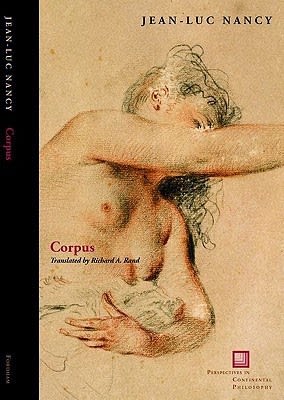
Jean-Luc Nancy, Corpus, translated by Richard A. Rand, publisher: Fordham University Press