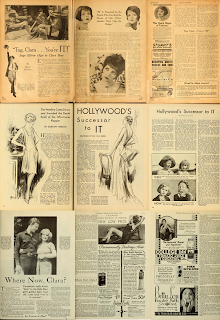
An analysis of three fan magazine articles relating to Clara Bow
___________________________________________________________________________________________________________
Ioannis Tsirkas
The role of the fan magazines to the configuration of the Hollywood’s Star System at its emergence and henceforth is a widely discussed subject of continuing interest among the film scholars. On this paper I will examine three articles drawn from the Motion Picture Magazine, The New Movie Magazine and Photoplay respectively[1], trying to analyse the insights they provide into the phenomenon of the Hollywood Stardom. The three articles’ common ground is that despite their reference to the silent film star Clara Bow in various ways, they apprehend her as the star who ‘epitomized the flapper era’ (Roach 2004, p.556).
The title of the first, written at 1927, article is ‘“Tag, Clara…You’re IT!” Says Elinor Glyn’. It is mainly an interview with Elinor Glyn about her choice of Clara Bow as protagonist of the then upcoming film It (d. Clarence G. Badger, USA, 1927) and her credit that Bow was indeed a star who had it, so inaugurating an indefinable term to date[2]. The author on the one hand introduces Clara as a “Flaming Flapper” and on the other confesses her being surprised by Glyn’s choice of Bow as she was not the average “Elinor Glyn type” heroine. After describing Bow as a “sharply individual” persona with a “take it or live it attitude”, namely a flapper girl, she concludes that it would be difficult for her to “change her type” for the film, in the sense that a star representative of a certain type cannot figure an incompatible one. The stars’ persona had to be identified with their film roles, or to get at least formed in a mutual way. It is not insignificant that defining at first it as something that certainly does not suggest “gentleness and serenity”, Elynor Glyn mentions that she does not intend to change Bow’s “individuality”. The choice of this word can be seen as an intersection of two different notions: this of the consensus that the need of a certain type for each star has to do with the marketing as regards the fundamental need of the studio to unfailingly create individual images for the stars and thus to increase its competitiveness, but more remarkably, this of the link of the individuality (in social manners) that a flapper girl represented with the existing image of Clara Bow. Glynn in her effort to define the term it provides three more absolutely important aspects of its nature, even until today, that the annomination the It girl has been established. Firstly, Glyn’s pretence that a person with it “draws others of both sexes” can be easily connected with the desire of the studios for stars with as many fans (of both sexes) as possible. Secondly, she also claims that it is “absolutely fatal” for somebody to discover that he has it, that he has to be “absolutely unself-conscious”[3]. The author then delineates the potential impact of the fan magazines on their own image and thus the possibility to get the better of it. Finally, with felicity she associates the notion of it with the flapper girls of the era. This will prove its essentiality for both Bow’s career and the stars’ difficulty to perambulate the boundaries of the ‘false stereotypes of the next [age]’ (Koszaski 1994, p.309) in general.
It is with a similar phrase that the second article dated from 1930 with the title ‘HOLLYWOOD’s Successor to IT’ starts calling to attention the disappearance of the flappers of the Hollywood Stardom: “They are today’s ash to yesterday’s flame of youth”. And as we now remember Clara was a flaming flapper… The first part of the article to a great extent focuses on the consonant with the flappers’ persona clothes fashion. Two reciprocal points arise here, the by its nature impermanence of fashion and by extension of stars, and its being inextricable with the outer image of the self in social manner significations. The author does not only seem to be apparently aware of the aforesaid points but also to insinuate them in a very ironical way, something not unusual for this type of articles on that time. After the author’s emphasis that Elinor Glyn singled Clara Bow and other stars “out of the many” (once again a mention to the importance of the differentiation of a star), Bow is presented as a “representer of the modern girl” of the flapper era, a girl with “rakish independence”. However along with the change in fashion she imputes as a contingent cause the coming of stage players from Brodway to Hollywood at the same time with the emergence of the talkies, therefore underlining their significant role to the change of the flapper mode as these new stars brought a new more sophisticated style. Curiously enough, this point seems to be the least discussed by the scholars. Thereinafter, she tries to define the “new personality” of the “modern girl of Hollywood” by using Lilyan Tashman, Loretta Young and “the rebel of today”. The absence of a star as paradigm in the third category proves the absence of a particular one who would be able to represent the third type, in the line of their being anyway described through a combination of film narratives. The construction hence of the new social types of the modern girl is based on the contexture of the films’ narratives which in their turn are created through a complementary process, intermingling the image of a particular star and the epoch’s calls. The article reaches the conclusion that Clara Bow has accepted the new order, that “Hollywood has grown up”[4] and that the next type of the modern girl will be a conflation of the above indicated ones. The need of Hollywood to meet the case or even to adopt the quickly passing socio-cultural norms is reflected almost explicitly.
The third article entitled ‘Where Now, Clara?’, written on 1931, begins exactly by mentioning the Paramount’s “stupendous efforts” to keep Clara Bow on the “wall of the public favour”. The author also draws attention to the imperative need for her to rise from her ashes through “proper handling, smart casting and a lot or road work”. The author pinpoints as reasons of her failure the bad publicity of the DeVoe scandal, the “sad succession of boy-friends” and the “welter of the talkie revolution” adding in a cynical way that all these would be on no significance for her studio if they had not caused her commercial failure. The emphasis on the studios’ strict impositions, even then, confirms the stars’ total reliance on their demands. After that, the reasons why the use of microphone in the talking films affected Bow are being developed. The author rightly claims (confirming also a widely accepted argument among scholars) that her “untrained and uninteresting voice” stole something of her image. And indeed, we can see the devolopement of sound in the films not only as a third dimension between the spectator and the screen, but also as a missing third dimension of a character’s personality. In the case of Bow, her not existing “cultural background”, as the article implies, has to be revealed in her fans. Of course, her background was already well known (through the fan magazines needless to say), so it would be more preferable to talk about a practical realization, since the “girlish figure” of Clara Bow in the “old-silent-days” remained insusceptible to the influence of the erewhile introduced sound and its demands from the existing stars. What is more worthy of notice is the fact that the author colligates the entry of sound to the films with the entry of the self-consciousness in the perception of Bow’s own image. According to the first article, this may explains the loss of what the fans had recognised to her, the loss of it, the loss of her alluring image they had been fascinated from. Her being characterised, after that, as a non grown up “child of It”, apart from the reasonable connotations it generates in comparison with the evolutional process of Hollywood for which we read in the second article, can be presumed as one of the first declaratory examples of how the succession of seasons and paradigms can affect a star’s career. Of course, on 1931 Bow was still a 26 years old girl, but given that her previous success was largely based on her “look” and on her ‘youthful sexuality’ (Felando 2004, p.8), what was made clear was the necessary conclusion that Bow could not anymore represent something either way already outdated. The article ends by depreciating Bow as a property, namely a property of studios (but also of her fans), a property with its value in crisis. The final joke of the author about somebody who was not unlikely able to predict the future of Bow connotes the notion of stars as both cultural and commercial stocks affected by the lapse and the changes of time.
As it was eventually illustrated from my analysis, sources as these, regardless their invariably lack of objectivity can stand as an adequate source of information about the Star System of this era, by either confirming pre-existent allegations or by providing new aspects of the Stardom’s various occurrences. Since those references many times consist the only source of information about Stars who are now dead and difficult to examine in academic terms, it would not be discrepant to claim that primary materials as such can be used as a valuable illuminating guide for the revival of a world once and for all bygone.
___________________________________
[1] See Carlisle 1927, Herzog 1930 and Hall 1931 in the bibliography.
[2] This article can be seen as a verification of Anne Morey’s (2006, p.113) inference that B. P. Schulberg of Paramount was interested to promote mainly It based on the sobriquet’s significance that Glyn assigned to Clara Bow.
[3] The importance of this particular phrase will be brought out only during the analysis of the third article.
[4] The significance of this phrase will come to the fore only in parallel with the analysis of the third article.
Bibliography
Carlisle, Helen (1927) ‘“Tag! Clara … You're IT!” Says Elinor Glyn to Clara Bow’, Motion Picture Magazine, XXXIII(1), pp. 42, 43, 116. Media History Digital Library [Online]. Available at: http://mediahistoryproject.org (Accessed: 10 October 2013).
Felando, Cynthia (2004) ‘Clara Bow is It’, in Andy Willis (ed.) Film Stars: Hollywood and Beyond. Manchester: Manchester University Press, pp. 8-24.
Hall, Leonard (1931) ‘Where Now, Clara?’, Photoplay, XL(3), pp.55, 113, 114. Media History Digital Library [Online]. Available at: http://mediahistoryproject.org (Accessed: 10 October 2013).
Herzog, Dorothy (1930) ‘Hollywood's Successor to IT’, The New Movie Magazine, II(2), pp. 38, 39, 108. Media History Digital Library [Online]. Available at: http://mediahistoryproject.org (Accessed: 10 October 2013).
Koszaski, Richard (1994) An Evening's Entertainment: The Age of the Silent Feature Film, 1915-1928. Berkeley: University of California.
Morey, Anne (2006) ‘Elinor Glyn as Hollywood Labourer’, Film History, 18(2), pp.110-118, [Online]. Available at: http://muse.jhu.edu/journals/fih/summary/v018/18.2morey.html (Accessed: 6 October 2013).
Roach, Joseph (2004) ‘It’, Theatre Journal, 56(4), pp. 555-568, [Online]. Available at: http://muse.jhu.edu/journals/theatre_journal/summary/v056/56.4roach.htht (Accessed: 6 October 2013).
Acknowledgment
Ι would like to express my sincere thanks to Christos Aggelakopoulos for his diligent philological support.